Monday, December 1, 2008

What is the poet trying to say?


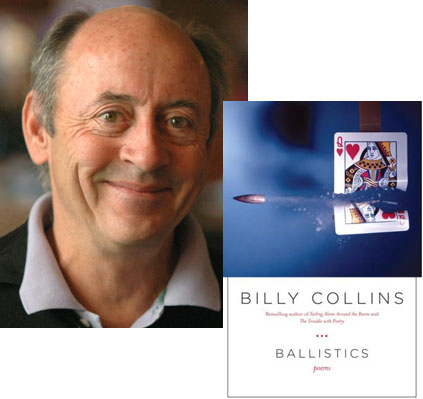
Yesterday, I stumbled upon "Effort" by Billy Collins in his new collection Ballistics. My uncle, Tom, had left the book lying on a table at my grandfather's house, so I picked it up and the pages fell open to "Effort." Collins's style always makes me feel as though the poet has sidled up to me at a family gathering to tell me an important (and well-composed) secret, and this time was no different.

(Disclaimer: I'm working from memory here, so please forgive me if I resort to paraphrase) The poem opens with a gentle rant against those teachers who always asked the question mentioned in the title. The speaker then gives us the comical image of Emily Dickinson chewing her pen, looking out the window, trying to figure out what to say. The rant resonates with me now especially because, as I am teaching a mixed-genre workshop here in my community, I often find myself in the position of having to either field this exact question, or listen to the not-so-gentle rants against my students' past teachers who pestered to death any potential love they may have had for poetry with said question.

Collins whispers slyly to the reader: It's okay not to know. And besides, you can relieve yourself of the responsibility of being the authority. The poem then turns cleverly to the speaker's own poetic subject. In letting his readers off the hook, Collins also excuses himself from having to make something with "absolute" meaning. He talks of absence, describes the night. And leaves it to future generations and future ruler-tapping high school teachers to figure out what it is he's been trying to say.

I appreciate the humor and candor in this poem, as well as the characteristic Collins humility that so incredibly accompanies such lovely language and elegant lines. I look forward to reading the rest of his new collection.

News of the submission slog: I am receiving rejections weekly, if not daily, these days. This at least proves I am doing the work of getting my poems out there. And most of my recent ones have been more than the one word, "No" that I once received by email. Can't say that I'd be unhappy to have an acceptance or two thrown into the mix. But I'll continue to slog on. Next targets: Beloit Poetry Journal and Minnetonka Review.

Happy December!

-- Jill

Monday, November 24, 2008

Poetic Doubt in Larissa Szpurlok’s Embryos & Idiots: Some (Rambling) Thoughts on Book 1; Submission News; Thanksgiving Poem

Hello Readers!

Lately, I’ve been reading Embryos & Idiots (2007 Tupelo Press). In the hopes of eventually forming a coherent review, here are some of my thoughts on the first section of the collection.

The complex association and allegory at work in Szpurlok's Embryos & Idiots is, at first glance, somewhat confounding. I am troubled, if that is the right word, because I cannot immediately obtain linear meaning. However, as I read and re-read, as I immerse myself in the sounds and semantics of the language, it becomes apparent that Szpurlok's collection avoids denotation (and celebrates its own associative and connotative systems) as a means to challenge the linear and representational modes of the myths the collection delights in undermining. Szpurlock's production of a mythic narrative (and her dissolution of that narrative) is a feminist critique of and response to the phallo-centric and patriarchic myths of Genesis and Paradise Lost. While this assignment places the collection in the realm of the public manifesta, the collection operates in the private sphere as well. In a number of instances in Book 1, the speaker breaks away from the allegorical narrative to question her audience. These questions represent an ongoing rhetorical trope of what seems to be poetic doubt. In the final line of "Boulders," the speaker asks "This Century wants anything. Is that a soul?" In "Idol": "Anoton spilled the secret- wouldn't we all to get what we want?" In "Reaper,"Does it matter what we're made of?" In "Passive-Aggressive Music": "and what's so important that it makes / you forget, like ammonia, everything? In "Naves and Navels," "Does anyone know? We who are old and full of words?" These types of questions are rampant in the first section of Embryos & Idiots and they are significant because they represent Szporluk's doubt yes, but also her need to validate her (anti-)myth (non)narrative. Her readers, it seems, have a crucial role to play in this process. Everyone else is either an Embryo or an Idiot.


In other news, I’m preparing submissions to American Poetry Review and New Ohio Review. I hope everyone is fortunate enough to be spending time with family and friends this week. Check out this Thanksgiving poem by Paul Laurence Dunbar to get into the holiday spirit. My favorite is: “Oomph! dat bird do' know whut's comin'; /Ef he did he'd shet his mouf.” Happy Thanksgiving!


-Matt

Monday, November 17, 2008

Sharon Olds: "The Clasp"

To pick up on Matt's themes of writing on the experience of living with children as well as his most recent theme of violence coexisting with beautiful restraint, I would like to offer Sharon Olds's "The Clasp." It contains perfectly within one small stanza the complex ambivalence of parental love.

It begins with a swinging, back-and-forth rhythm: "She was four, he was one, it was raining, we had colds," (1). The rocking syntax of the four quick phrases helps the speaker lay out the facts of the situation while drawing the reader's ear and body into the music of the line. The following line relaxes into a longer clause, though it still resists a full stop: "we had been in the apartment two weeks straight," (2). The reader quickly understands that this lyric will be a confession and prepares to be sympathetic. Anyone, parent or not, who has spent five minutes with children can immediately see the inherent tension in the set up. The narrative then moves to the central action: the mother-speaker grabs the wrist of the older child to "keep her from shoving him over onto his / face, again"-- a perfectly understandable move (3-4)..

The real drama, however, occurs in less than a second, when the mother squeezes her daughter's wrist "to make an impression on her" (6); she reports savoring the stinging sensation, the "expression, into her, of my anger" (9). But the poem shifts again, from the "righteous chant" and staccato rhythms-- grab crush release-- to the parent observing her child experiencing her own revelation: "she learned me. This was her mother, one of the / two whom she loved most, the two / who loved her the most, near the source of love" (19-21). The intimate, innocent mother-daughter relationship deepens a level to envelop something dark. The mother watching the child learn this allows the reader to be present at the moment of the mother's realization. They hurtle together closer to the "source of love," and find "this"-- the speaker refers to the anger only with a pronoun, for the word anger cannot contain all of what "this" stands for: the moment, the learning of something big about the world from a child, the violence, the perverse enjoyment of it, the protecting of one child at the expense of another, and all the subtleties of emotion that occur in a moment of intense loving.

The exercise of writing this post reminds me of the frustration inherent in trying to "explain" a poem. So I recommend you find the poem, read it, and experience the "this" for yourself. I found it in Not For Mothers Only, which I am still reading with pleasure. You can find the full text on the web at http://www.poemhunter.com/poem/the-clasp/.

-- Jill

Monday, November 10, 2008

Some Thoughts on “Winter Mix” and “Chaos Theory,” from Carol Ann Davis’ Psalm

Lately, I’ve been reading Carol Ann Davis' Psalm, a collection of poems which explores, among other things, the speaker’s grief at the death of her father.

These poems are at once intensely violent and beautifully restrained. One of my favorites from the collection is "Winter Mix," which begins, "This is a day with ghosts in it, / with husks and some kind of confession at its heart." These lines serve to introduce the poem, as well as the scene. The reader is lead to the next couplet expecting these ghosts, expecting a confession. The ghosts, it seems are represented in the speaker’s meditation on her dead father's photograph: "One day I won't wake up to my father's portrait. / I'll take it and put it / in the sitting room / and it will become small to me." The speaker's prediction that she will overcome her grief is followed by the confession that this will not happen for some time. In the final lines of the poem, the speaker describes the power of the photograph, and the power of her father to transport and transform her "into cumulus and cirrus, / into ganglia and spine, / into zephyrs and waves." This seems to be the most powerful moment of the poem. By contemplating her father's death, the speaker envisions her own "death," her metamorphosis into something utterly non-human. But it is a metamorphosis she admits she is unprepared for when she confesses in the final two lines: "I'm sorry / to come with empty hands."


Another favorite is "Chaos Theory." Highly abstract and experimental, "Chaos Theory" consists of a number of anaphoric, one-line stanzas gathered together under the unified banner of "Chaos Theory," a highly complex mathematical theory, which attempts to explain the random behavior of systems which are defined as having deterministic properties. The theory is confusing, to say the least, but its complexity is indicative of the intricacy of the levels of narrative or non-narrative at work in the collection as a whole. I say narrative OR non-narrative to emphasize the irregular forces of voice, structure and meaning at work in the collection- all of which contribute to the total dissolution of narration taking place in Psalm. "Chaos Theory," while it is a beautiful and random poem in and of itself, acquires its meaning from the poems in the collection which surround it. It emphasizes the notion that the grief of a physical loss is also a metaphysical loss, a loss of meaning, a loss of language.

Hope everyone is well.

-Matthew

Monday, November 3, 2008

Visual Poetry II


As promised, here are the images from Eleni Sikelianos's poem, "Experiments with Minutes." Notice again how creation of the images spur the text, rather than the other way around. (Apologies for the quality of the pictures; I'm a poet, not a photographer.)

At Matt's suggestion, I delved into this month's issue of Poetry Magazine, and wow! I was overwhelmed by the variety and ingenuity of the visual poetry in this issue. Geof Huth's commentary on the works is fun and enlightening, too. He has written a longer article available online, too, at http://www.poetryfoundation.org/journal/feature.html?id=182397.

I'd love to talk about each poem, but for the sake of focusing, I'm going to choose Joel Lipman's excerpt from "Origins of Poetry" (to view the poem see http://www.poetryfoundation.org/archive/poem.html?id=182405). What appeals to me about this poem is the overlapping and interaction between the two texts: the "found" text of the old science book and Lipman's rubber stamp composition. Layering in this way mimics the way in which we are always composing on a palimpsest, one that is never completely erased. Each voice is merely a part in the chorus, and yet, Lipman's lines are clearly the soloist of this piece. Other graphic features-- squiggles, red dots-- also call attention to the artifice, which helps guide the reader's attention. The harmony parts, though, are still audible, and the sheer fun of writing a poem with a title as grandiose as "Origins of Poetry" on a tract about magnetism and electricity makes unimaginable connections possible. Perhaps the origins of poetry are as fundamental as the laws of magnetism. In this way, Lipman's poem aligns itself with the others in this issue: each one questions the origins, and in the process, the limits of language and poetry. A worthy experiment, whether you call it science or linguistics or art or all of the above.

Thanks to Matt for the tip! -- Jill

Monday, October 27, 2008

SAMLA, etc

Hello Faithful Readers!

Please excuse this short and inconsequential post. I'm staying busy this week preparing a visual presentation for the SAMLA Convention Nov 7-9 in Louisville, KY. When I first proposed a topic over the summer, I had no idea these things were so expensive. I'm estimating membership, registration, and printing costs at around $300! I want to build my vita, but is it worth it?

Obviously, this is my first time doing this kind of thing, and I have to admit, I'm a little nervous. Anyone ever done a conference visual presentation? Any advice?

In other news, I got a poem picked up by L.A. Review, and am waiting to hear from Poetry, ABZ, Greensboro Review, and Crazyhorse. Where are you submitting?

Matthew


*Update

I heard from Poetry Magazine after I posted this. Here's what the editors had to say:


Thank you for sending us your work.

We're sorry to say that nothing in this particular submission was quite right for us, but we were impressed. We hope that you will feel encouraged by this short note to send us more work after a while.

Monday, October 20, 2008

Graphic Poetry and Eleni Sikelianos

Lately, I've been curious about how illustrations and poetry might work together. One of my mentors, Molly Peacock, sparked this seed-idea a few months ago, and it's been growing slowly ever since. I read Marjane Satrapi's amazing graphic memoir, Persepolis, this summer, and it struck me how pictures can move a narrative so effectively while also conveying much emotional information. I've been wondering how that might work in the context of a less narrative form, like lyric poetry.

One of Eleni Sikelianos's poems gave a window into what a partnership between drawing and writing can produce. The following is from "Experiments with Minutes":

If we could shine a flashlight
through the edge of a minute
see the membrane's red
corpuscle, & surface
tension of a second at
the interior atmosphere of an hour
Move the flashlight out
on eternity-- possible? Not. (Duh.)

Below this stanza is a reproduction of what looks to be a postcard or a page from a notebook, which is a sort of graphic, but is still words. The handwriting itself becomes an illustration of a mental process. Sikelianos tries to visualize the invisible. She begins with the "if" that is usually the domain of fiction writers. Poets don't as often seem to speculate. I love that the minutes is conceived as membrane, human tissue (this poems is in fact from a larger collection, Body Clock). I also love the thinky aspect of the language and syntax. The speaker tries on a thought, then rejects it, almost as quickly.

Having already arrived at a dead end, the speaker turns to the non-verbal and begins to draw. What follows is a circle filled with tiny dots. Then, this:

In this conception a minute is round though not perfectly -- its lines disconnect in the drawing of it to meet up with the next / past minute. You might see the small freckles of scattered seconds at the interior (heart-meat) of the minute.

This is a big-meat minute true to its actual size but only took 34 seconds to draw.

What struck me as so original about this graphic poem is the function drawing plays in the poem. Rather than being an illustration of the narrative, the act of drawing creates experience upon which the poem itself is based. The artist/speaker is free to play with the image because it represents something intangible anyway. The language reflects this playfulness: "conception" (birth metaphors) and "heart-meat" (instead of heart beat) are two examples.

Several more very similar looking drawings follow, with reflections on their creations. I urge you read the rest of this poem. I found it in the anthology Not for Mothers Only. I'd also love to hear from you if you know of any other poets working in graphic forms.

P. S. I will try to post a picture of the poem later today so you can see the drawings, too.